“These trails provide a chance for community to heal from past trauma, and also to share their stories with future generations.”
The Oodnadatta trails were opened in 2019 for use by residents and visitors. The two mixed-use trails explore the rich history, language and culture of the area and are appropriate for walking, bike riding and driving. Users follow the map (download below) to markers which are placed along the trails at significant sites. Trail markers include placenames in Lower Arrernte and Yankunytjatjara languages, as well as in English. This mix of languages acknowledges and respects the layers of cultural and social history of Oodnadatta and its surrounds.
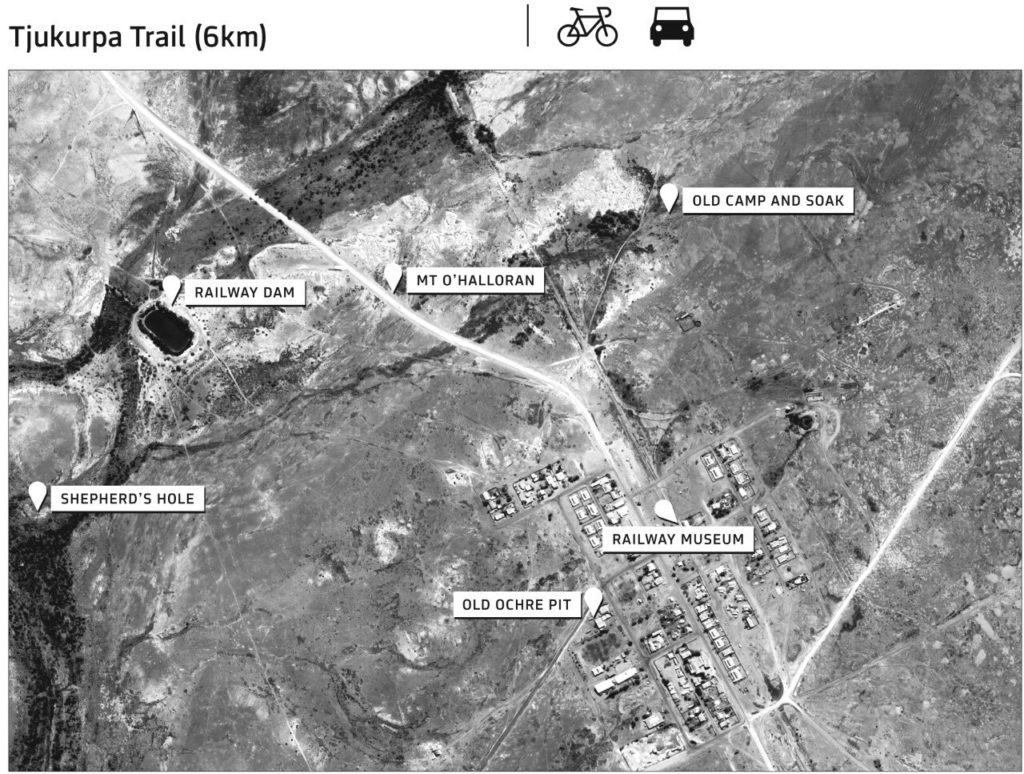
Tjukurpa trail
The Tjukurpa trail is a mixed-use trail which takes users on a journey through the Aboriginal history of Oodnadatta. Tjukurpa is a Yankunytjatjara word which can be translated as ‘Dreaming’, ‘Story’ or ‘History’. This trail is a wide loop on the outskirts of town which highlights many sites including an old camp and an ochre pit. It is approx. 6km long (1.5hrs walking) and is most suited to driving and bike riding.
Click the links below to learn more about the trail sites. Lower Arrernte placenames, followed by Yankunytjatjara placenames are displayed.
Stolen Generations trail
The Stolen Generations trail is a loop around the township which highlights sites of importance to the social history of Aboriginal people, including the Colebrook United Aboriginal Mission (UAM) and Oodnadatta Aboriginal children’s hostel, which played central roles in the Stolen Generations era. This trail is approx. 4km long (1hr walking) and is most suited to walking and bike riding.
The museum is the start of both trails and is opposite the Trail Head sign. Hire the key from the Pink Roadhouse and learn more about the rich history of Oodnadatta.
Anangu Tjutaku Ngura Wilurara
Yankunytjatjara
The vacant lot on the north side of Oribee Ave was originally the hospital reserve. Until the mid 1980s people still lived here in canvas and tin shelters. Passing along Oribee Ave in the 1950s, Haine's cakeshop and Manjaloon’s emporium would have been on your left. Beyond the police station are the old Afghan goat-yards, where young Aboriginal goat herds would round up the goats each evening.
Makumpaku Iwara Yankunytjatjara
This road connects Oodnadatta to Macumba station. Macumba Station was established in the 1980s and was an important site for rations distribution and work for Aboriginal people. There were up to 400 people here at any one time. This place was also an important section of the Fire Tjukurpa (History, Dreaming).
Anangu Tjutaku Ngura Kakarara
Yankunytjatjara
Aboriginal groups would make camp on the east or west side of town in canvas or tin shelters. These camps were occupied until the 1980s and some people who used to live here now live in Oodnadatta town. Visiting Aboriginal groups would make their camp on the side of town which was closest to their home country. Groups of people would move camp depending on the season or weather conditions, or for cultural reasons, such as a death at the camp.
Tjitji Tjutaku Ngura Yankunytjatjara
A cement slab is all that remains of the United Aborigines Mission (UAM) site, initially known as the UAM Colebrook Home and then as the UAM Oodnadatta Children's Home. Opened in 1924, this was the first of many UAM facilities across the country. The children taken here included those of Arrernte, Arabana, Yankunytjatjara and Pitjantjatjara backgrounds. These children were part of the Stolen Generation, and were separated from their families, language and culture. In 1927, in an effort to further isolate the children from their culture, the Sisters moved the children to Quorn and opened the new Colebrook Children's Home. In 1944 the children were again moved to Eden Hills, near Adelaide. Finally, some children were relocated to the Oodnadatta Aboriginal Children's Hostel.
Tjitjiku Ngura Yankunytjatjara
From 1971 to 1986 the Oodnadatta Aboriginal Children's Hostel was funded by the Commonwealth Government and run by the Save the Children Fund in consultation with the Department of Aboriginal Affairs. The superintendent of the hostel originally worked for the United Aborigines Mission (UAM). The majority of children residing in the hostel were transferred here from one of UAM's many Children's Homes. The children were from many different language groups and were part of the Stolen Generation, separated from family, language and culture. The building still remains.

Ardugula Aboriginal Corporation and partners acknowledges the support of the South Australian Government’s Stolen Generations Community Reparation Fund for the development of these trails.
Cover photo of men in front of the Transcontinental hotel (Oodnadatta, c. 1908) SAMA 1083-15-3208, courtesy of the South Australian Museum.

